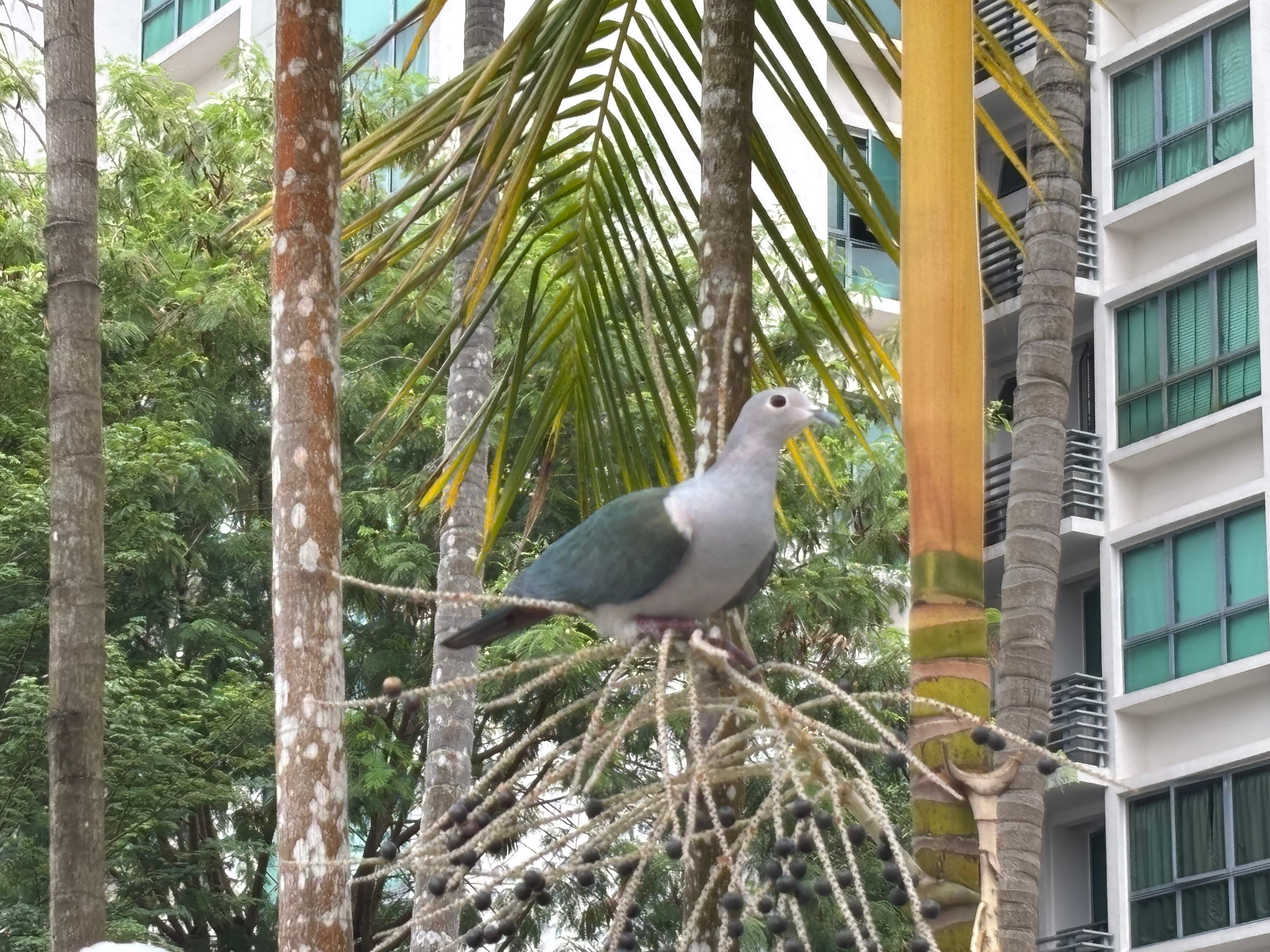
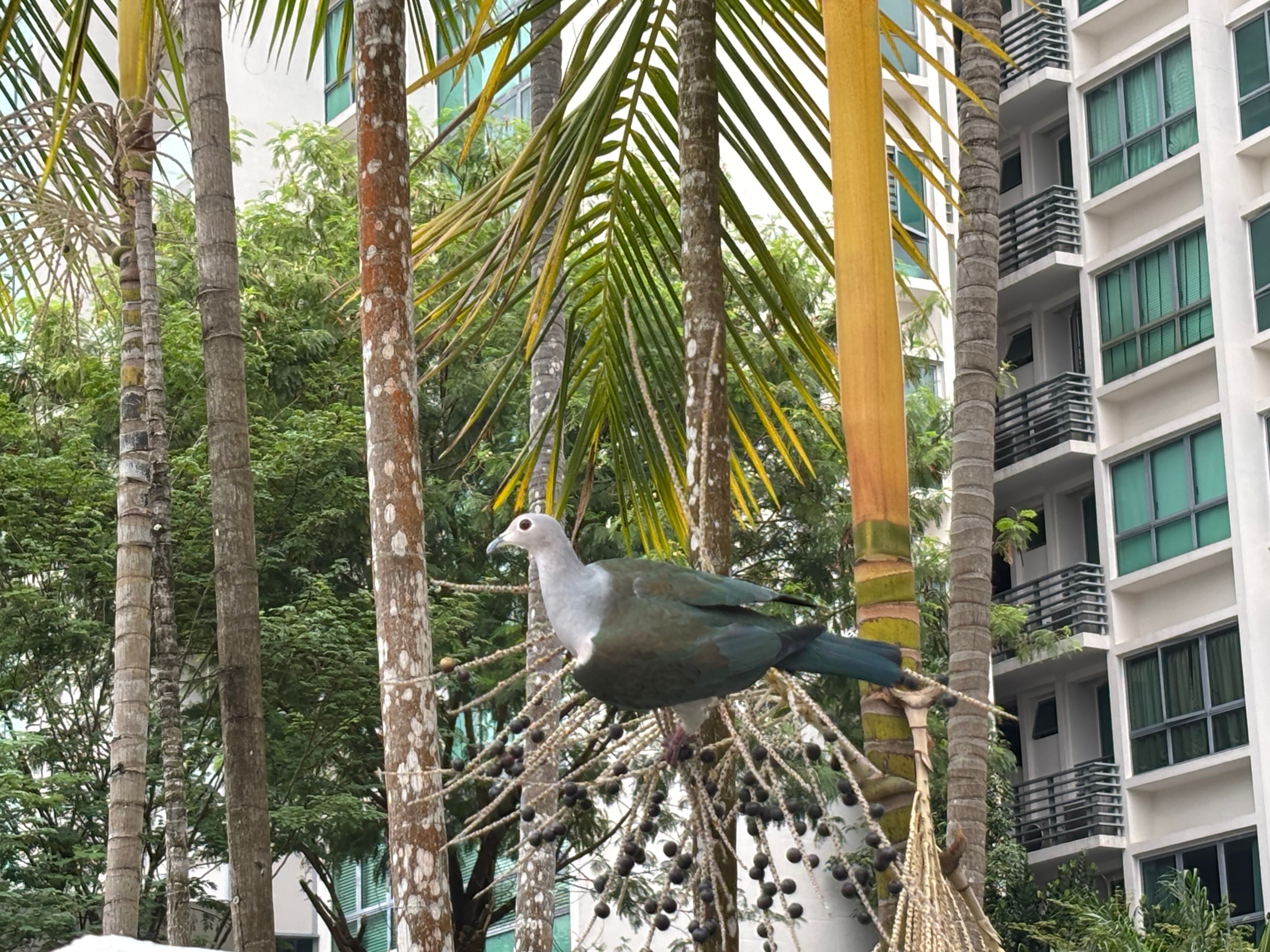
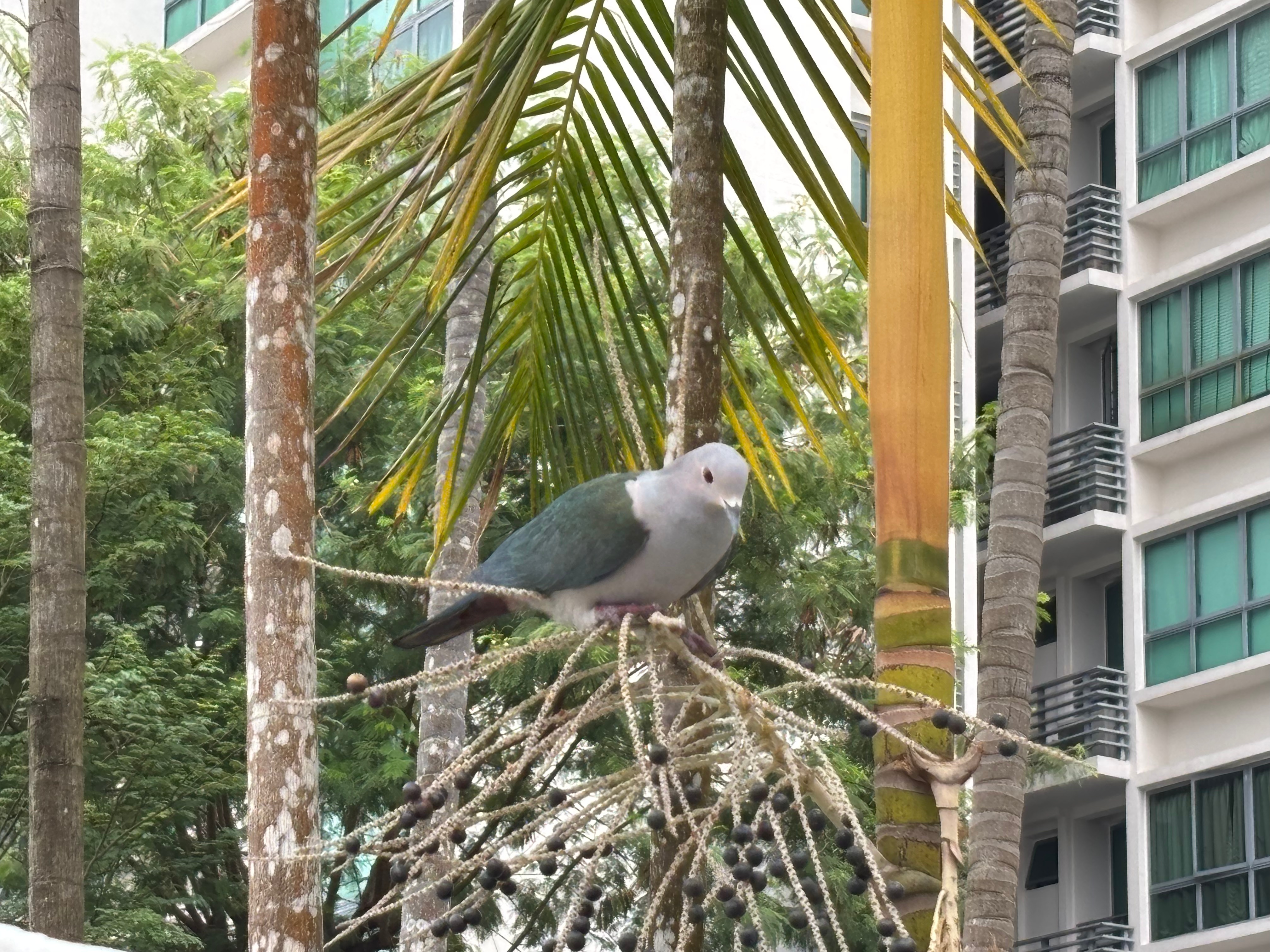
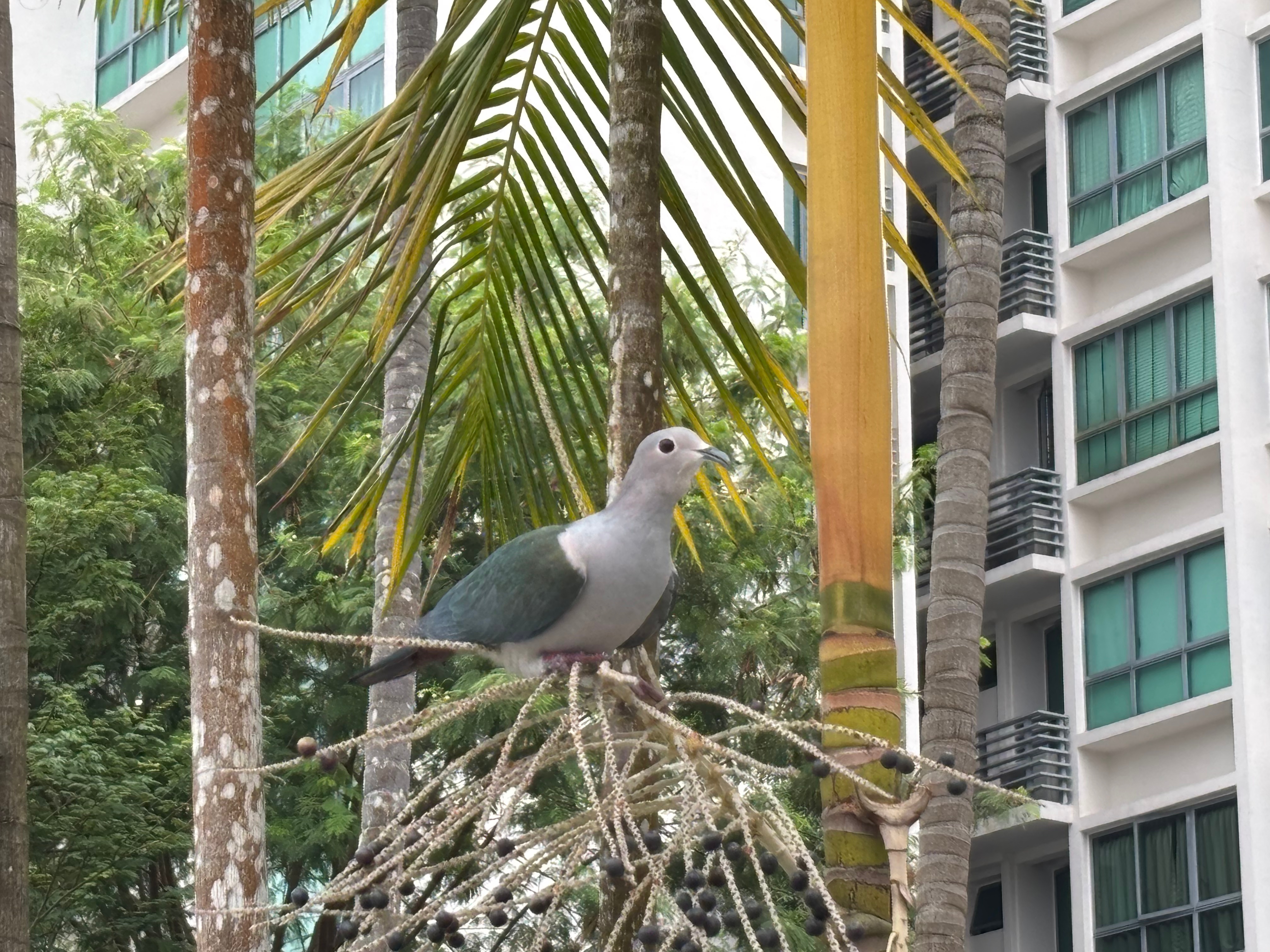
As serendipity would have it, I encountered this mysterious bird up close the other day:
To be clear, it was not the first time I have encountered it in where I live (Upper Changi) – I have spotted it before on the palm trees surrounding my condominium’s tennis court – but it is my first time beholding it within arm’s length while on my way to the bus stop.
Certainly, I was thrilled and paused to observe, being careful to keep my movements gentle lest I startle her.
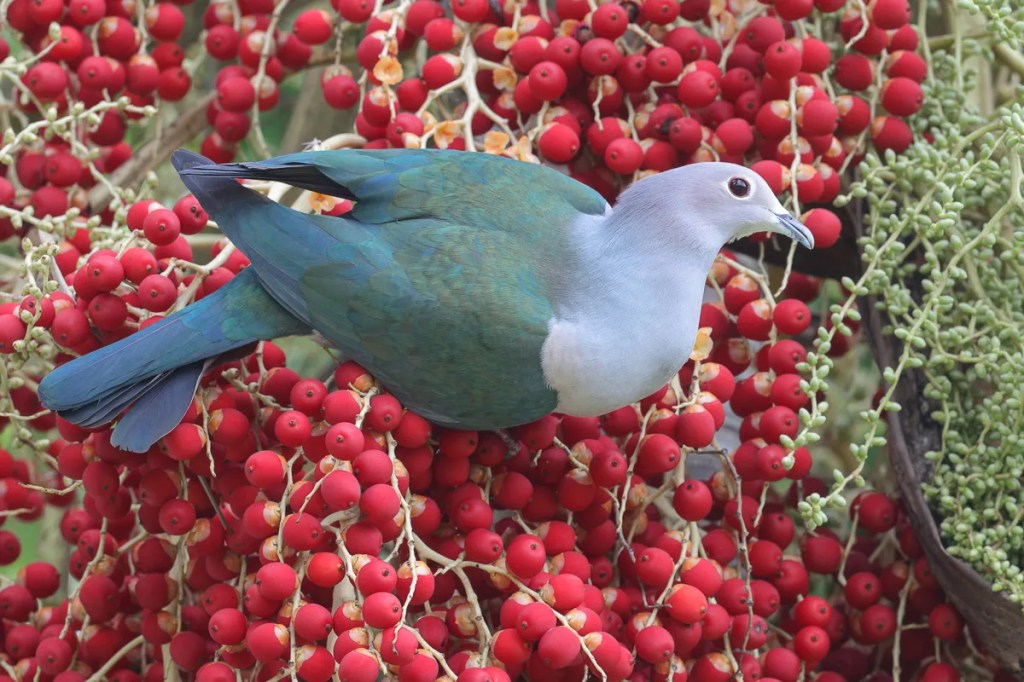
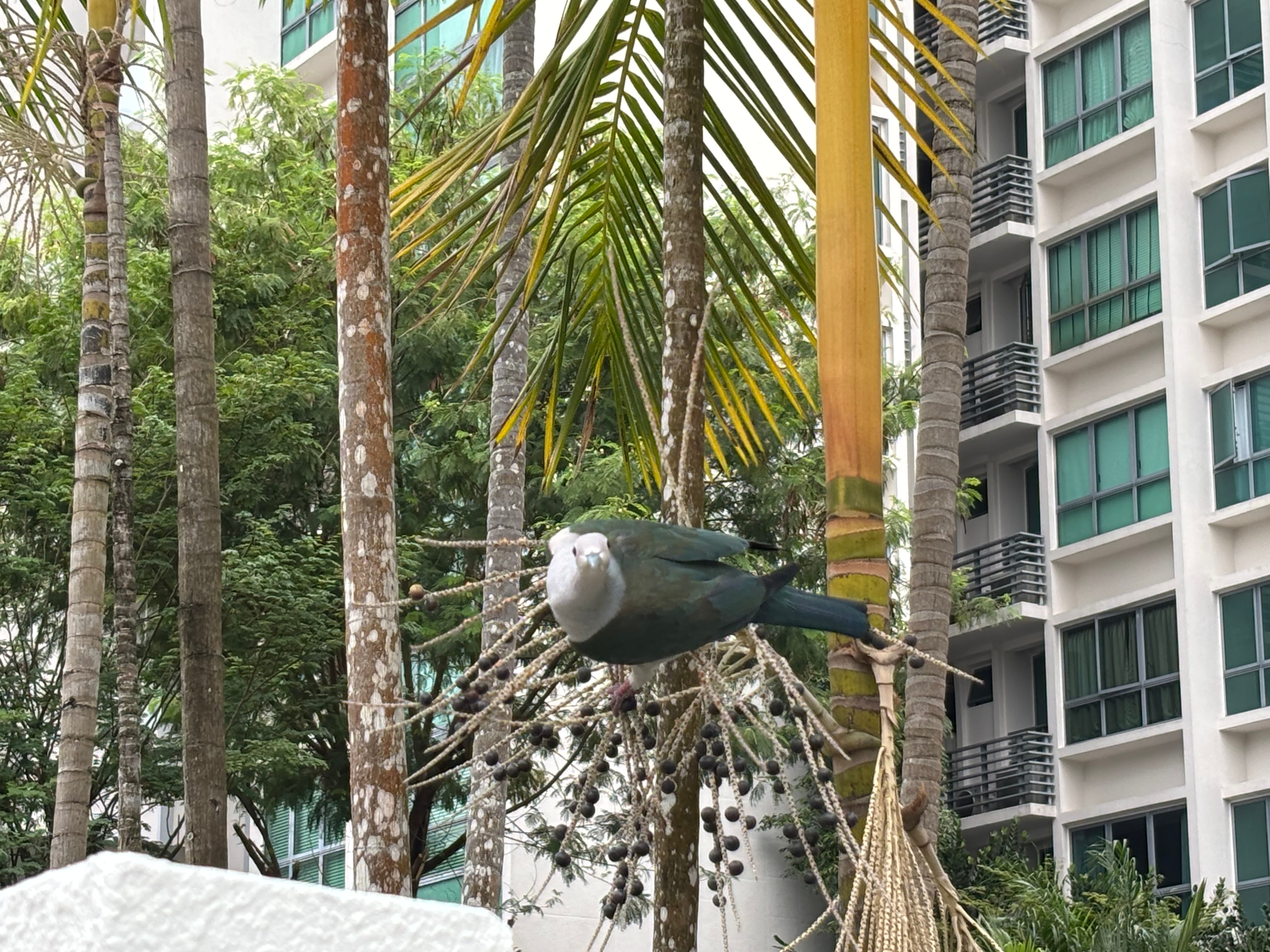
“Majestic. Stately. Bright-eyed”, are adjectives that come to my mind when I looked. It was without a doubt a pigeon or a dove and had wing feathers resembling a peacock-green with its almost iridescent green which complementarily matched a light grey neck and pinkish feet. Her pupils are another sight to behold in its maroon-like tinge reflected in them. Intrigued by its presence, I felt an instinctual urge to wave at it, curious to see how she would respond, which to my relief – after a few shifts and turns – remained resolute in her position.
This time keeping my hands close to myself, I discreetly took some pictures and continued to watch and lo, and behold! She began feasting on the fruits – no wonder she stayed!
A sight to behold, A joy to watch, So trite a thing as some might mock, “A Bird? A Pigeon? Haven’t you seen one in your life?”
But if you heed not Presumption’s take, To bypass familiarity, and to still the rush. To pause. To look. To muse away –
And then you’ll see the magnificent fowl, Commonplace or rare, Our inhabitants of sky.
Each one unique, In colours – the obvious – In calls – sometimes pleasant – In temperament – the thrill!
So it is to witness the sight of one, The uncommon pigeon with the Greenish coat, Stout, Grey-neck, Red-eyes, With a sense of pomp, Whose name is fitting To how it is:
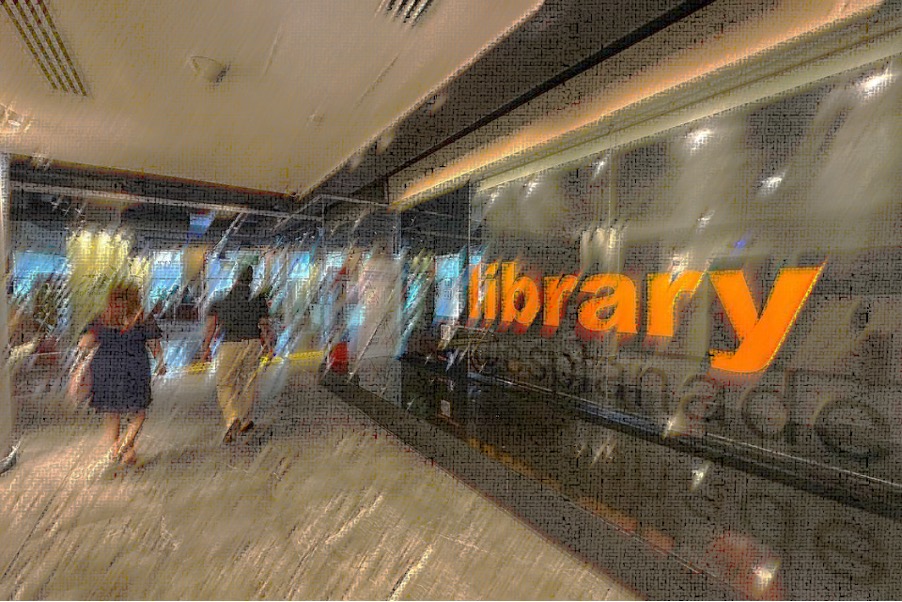
It will forever remain as one of my favourite places in Singapore insofar as my memory stays in tact, and undesirably but ineluctably, accompanying that memory, lies a deep grievance that such a treasure of a place is now gone – targetted, enveloped and destroyed into bits (yet again, as I see it) by commercial interests and utilitarian intents:
“Singapore’s only public library dedicated to the performing arts – library@esplanade – will close on June 30 (20231), and its collections and programmes will be moved to the National Library Building in the Bras Basah area… the move will allow it to centralise its arts resources in the heart of the Civic District, where they will be close to arts institutions and practitioners in the area…
The premises currently occupied by library@esplanade will be converted by Esplanade – Theatres on the Bay into arts and commercial spaces…” (Source: The Straits Times)
– as if a library is no more than a mere transferrable storage warehouse for books and resources, and place-making all but non-existent – even despised? Well, on the one hand, this should not be surprising for such is the natural outcome of a society that knows the price of everything but the value of nothing, where all interests are essentially utilitarian and economically motivated, where places exists primarily for the sake of efficiency, productivity, and – who are we kidding – profitability. And so, all who get in utility’s way will be wallowed up, dissolved, and remade into its image.
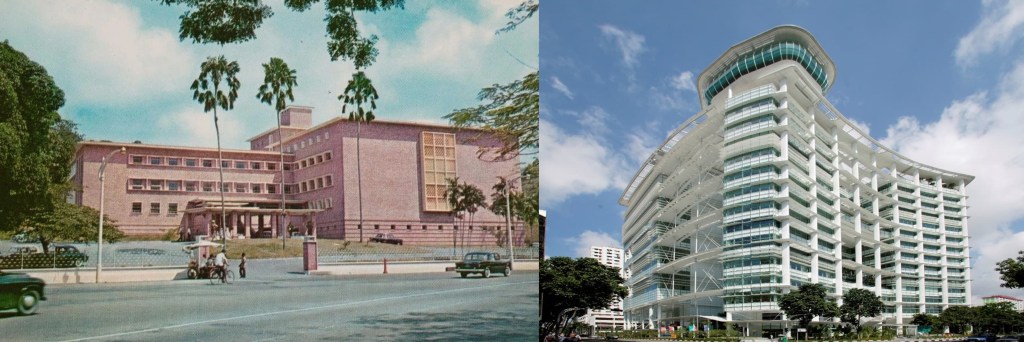
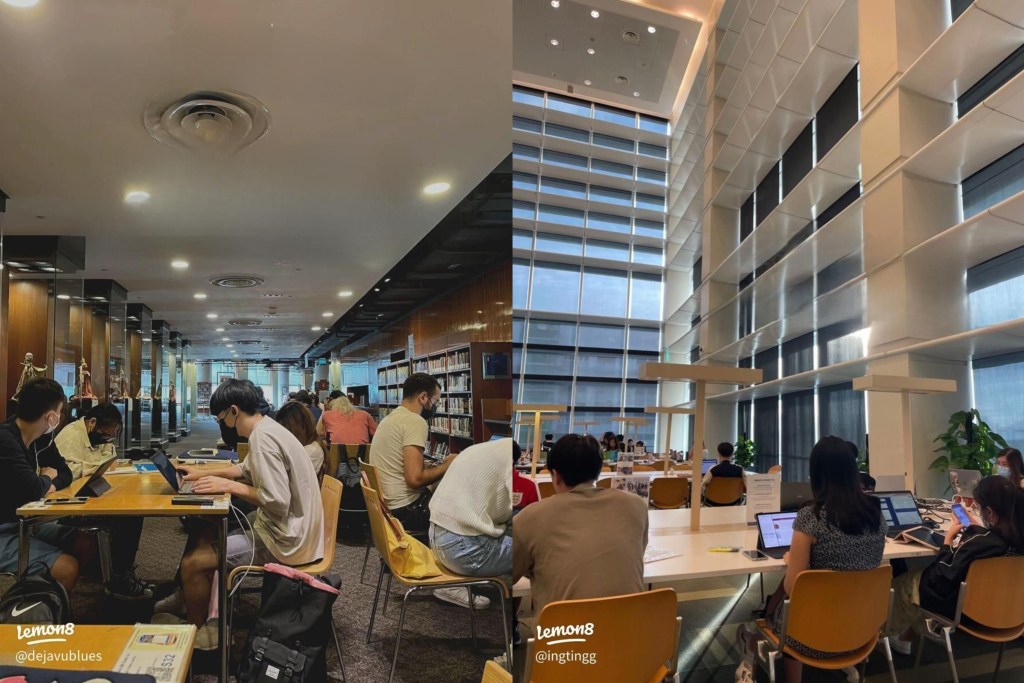
Is it no small wonder then that theNational library (yes Singapore’s flagship library) looks and feels atrociously sterile resembling a laboratory (or if you prefer, a learning laboratory) for rats and machines for production purposes rather than a warm and inviting space for learners to find solace, delight, and inspiration to explore, connect, and create? Look at the comparison between the exterior of the old National Library and the current, and then the interior of the current National library against the then-Esplanade Library:
The Rustic Charm of the Old National Library against the Sterile-looking “Learning-Laboratory” National Library of the present (Image sources: Roots and NLB) The ‘homeliness’ of the Esplanade Library of the past (left) against the laboratory-like tables of the present National Library (right) [Image source: Lemon8]
As it is, as mentioned, on the one hand, it should not be surprising to witness the failures of our country’s conservation efforts and declining quality of buildings for they merely reflect our culture’s core beliefs but yet on the other hand, in spite of one’s preparedness, the shock and sadness that result in actually losing a beloved (be it a person or place or anything for that matter) must be squarely acknowledged…
I know not when that I encountered the space, But pleasantly surprised was what I felt, “A library in the Esplanade? “Now that’s interesting.”
In curiosity’s trial I treaded along, Up the escalator and around I turned, Greeted by art which adorned the side-walls, Admiring-walking… I encounter an impasse – Or so I thought.
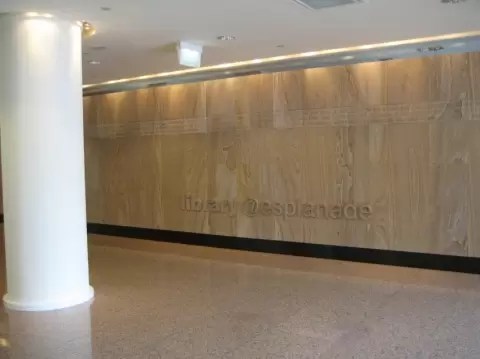
On the woody wall the engraving is there: “library@esplanade” to direct one’s path. And so I resumed walking along, an intriguing opening materialising before my eyes…
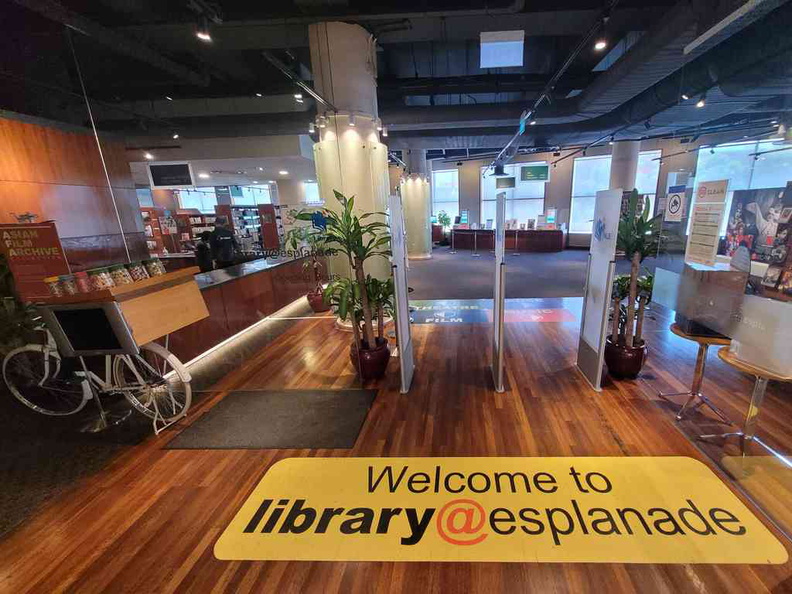
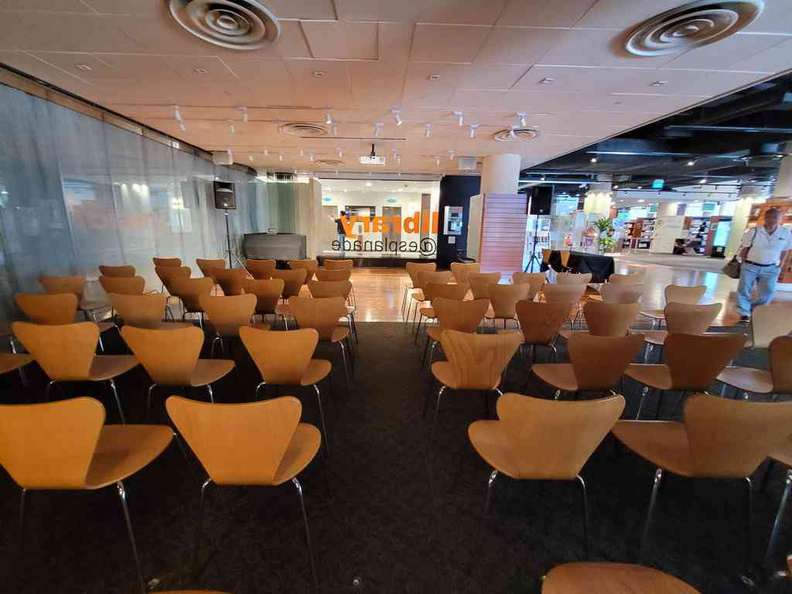
The entrance. Spacious, warm, and inviting. Clearly distinct from its paquet flooring, Extending around To the performance stage. A hallowed ground? A defined entry? A crossroad I say To decide the next route.
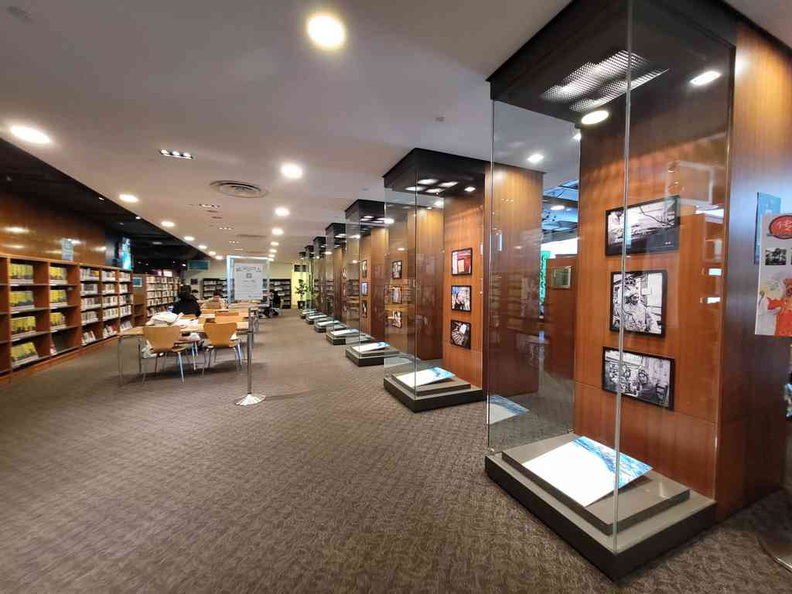
To the left three things stand out, two involving seats, and one an art display. On the latter, Many a time I have paused to look At the art encased in the column rows, Lining up toward the tables and chairs – the study area that is – That place I spent In hours galore To get work done Or simply to read.
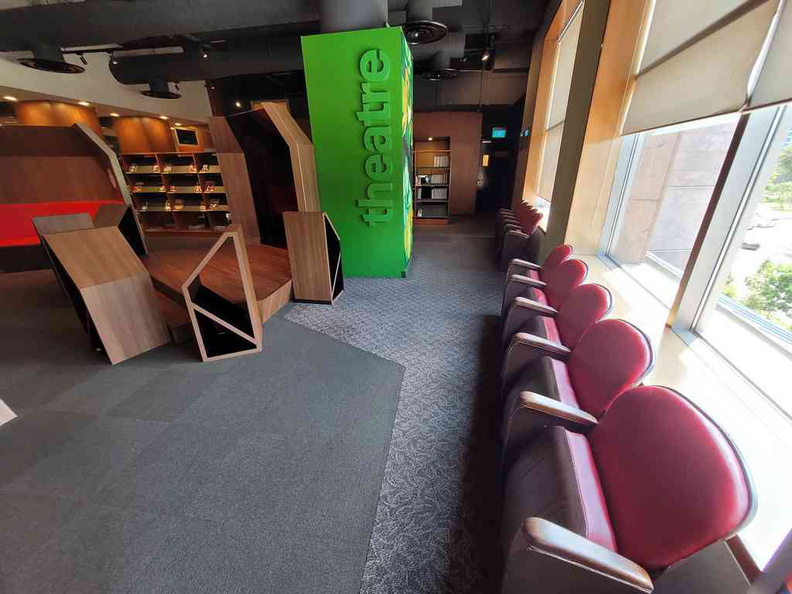
The other seats are one-of-a-kind. For those puffy red chairs are found in cinemas no more. They clang and cling when one uses them, But still it’s a joy to give them life. For their comfort? Not so much. But for their uniqueness and richness? Most absolutely yes!
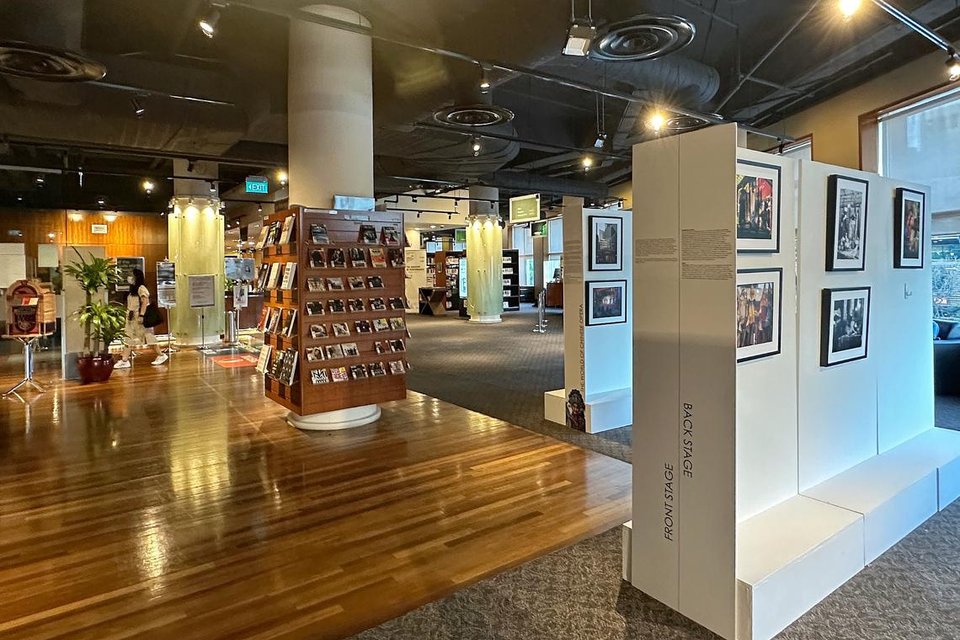
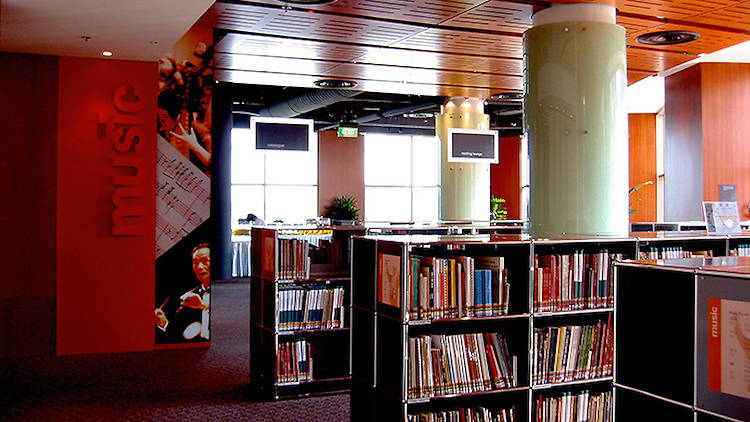
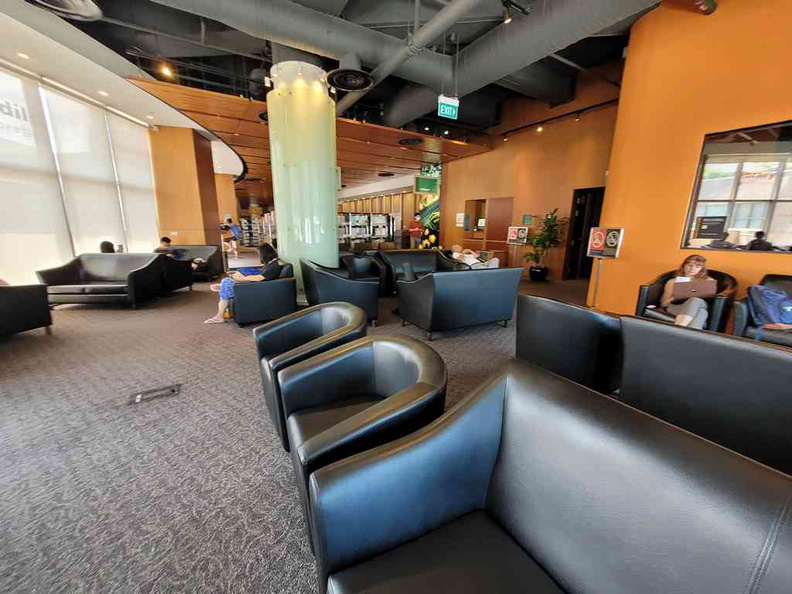
To the right from the entrance, Gives a different vibe. If the left wing is Yang, Then the right wing is Yin. Mellow, dark, and subdued in buzz, Yet not a cave but a haven light-shone, Where one can bask In the silence and sights…
And if you’re lucky, From time to time, Sounds adorn the silence, Free and Raw, That refreshes and sparks, Of all attuned, The pleasures to have, When live music is heard.
So why would you steal, This treasured place from us? Lessoning the count Of spaces adored – of places tried?
If it’s progress you say that warrants such acts, Then why does it feel that the opposite is true?
A sense of connection Eroding away, Giving way to function Disregarding form. Beauty bereft Efficiency King, Leave no room for structures That provide no price.
And so it was For the 21 year old library, In what remains – A memory.
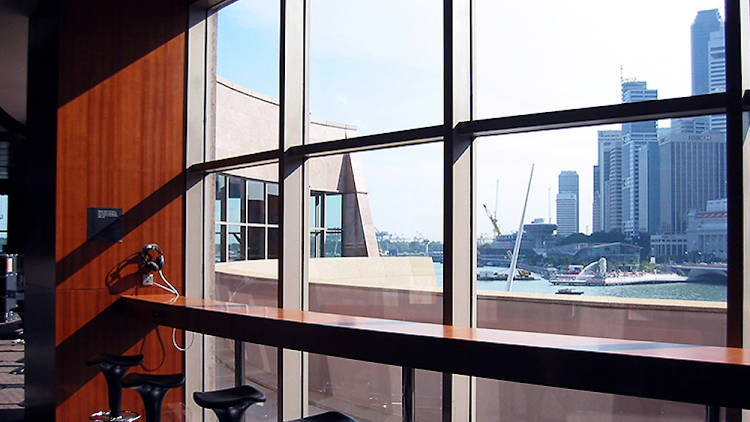
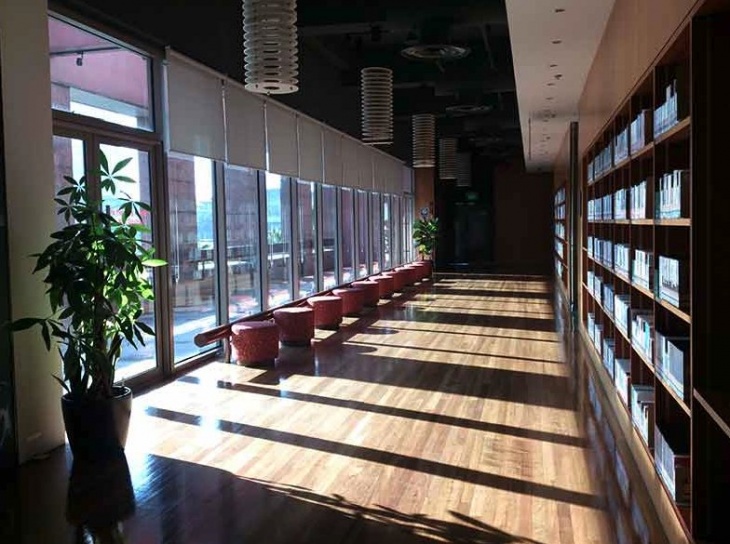
A favourite spot of mine in the right wing (Image Source: TimeOut)
The “Impasse” (Image Source: Wikipedia)
The Entrance (Image Source: Shaun Chng)
The Entrance (Image Source: The Straits Times)
The performance stage (image source: Shaun Chng)
The art display (Image Source: Shaun Chng)
The “puffy red” chairs in the left wing (Image Source: Shuan Chng)
Part of the right wing (Image Source: TimeOut)
Part of the right wing overlooking Marina Bay (Image Source: Shuan Chng)
Dance book section in the right wing (Image Source: TickiKIDS)
Who would have thought in the thick of estates – where I reside – could be found not mere men, but birds in array –
The common Myna, of course, And the Pigeons as well. Flamebacks. Hornbills. Koels. Parakeets. Doves. Orioles. Sparrows. Munias. – Yes they are here (to my disbelief) As patrons and neighbours – a motley crew – Who add to the interests, with their sightings and sounds, Of those who see past The generic bird.
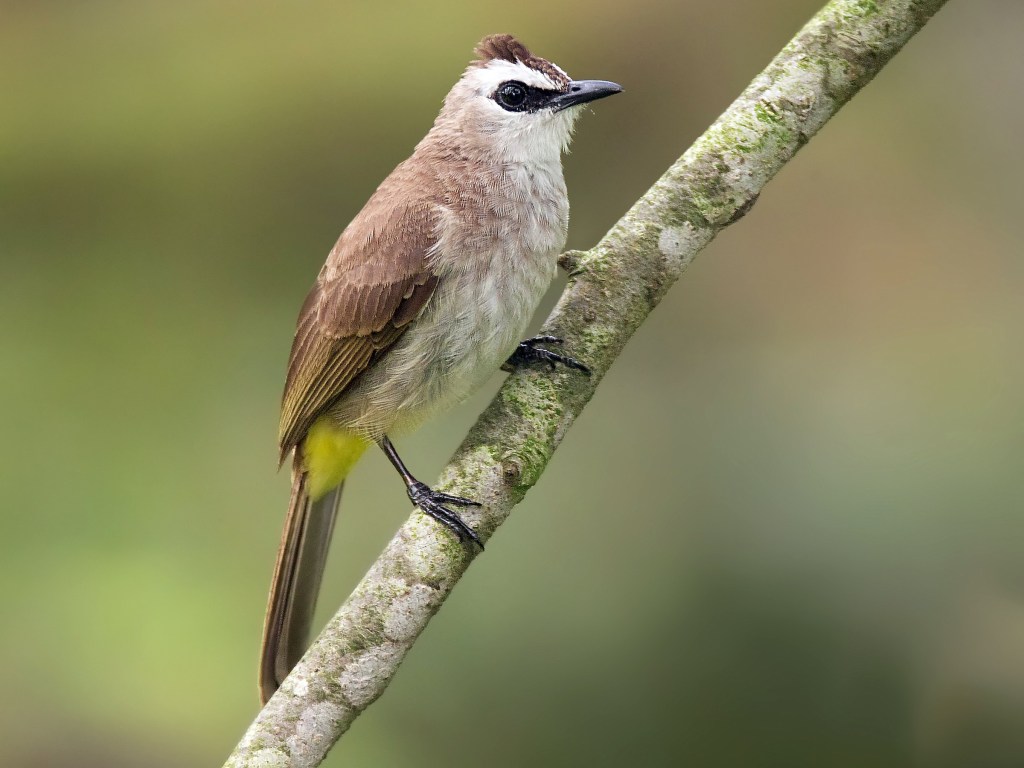
Now there is one fowl Which is not in the list, Intentionally left out To particularise. What is she called?
I wonder…
Is it a sparrow? (which at first I thought) Though brown, it is not. A tad too large? Yes, definitely too large. A broad elongated tail? Can’t be a sparrow. And look – Wow! – its head! Look at its head! Handsomely white with a streak of black, The kind which garners second looks. But that’s not all. For its movement is flamboyant, Resembling a dancer – a flamenco dancer, to be exact – In her long-laced dress, she Hops, Turns, Switches, Suspends
– and Swoosh!
Alas, she is gone! Her beauty missed. The one held dear but gone with the wind.
When will I see her – again and again? Oh. But what is she called? Yes, what is she called?
If you were to ask me which area of Singapore is my favourite, I would unhesitatingly reply the “East” but particularly Tampines, Simei, and Pasir Ris. If you were to probe further to ask why do I fancy the “East”, my reply would be because of the unique bucolic “homey” vibe it exudes. Could it be due to a biased preference since I have been living in the “East” all my life? Possibly, but I could also list down objective reasons for my preference such as its interesting circular streets, landscaping, open spaces, lower rise buildings (due to its close proximity to the airport) enabling one to see more of the skyline, and also its organicity and “homeliness” – which, sad to see, is fast dissipating due to frenetic (even vulgar) development in a utilitarian world.
But gloom aside, I would like to highlight and commemorate one prime vestige of such organicity evinced in – what I would call – the “good old flats” of Pasir Ris.
Back in 2022, I had a serendipitous encounter with the “Pasir Ris Heritage Trial” while researching on places in Singapore to explore as part of my fulfilment of a module in teacher-college (National Institute of Education) which I eventually embarked on. That solo trip and showcase after (through an artefact which we have to create – which is made available below) led me to delve deeper into the architecture of the old public housing flats.
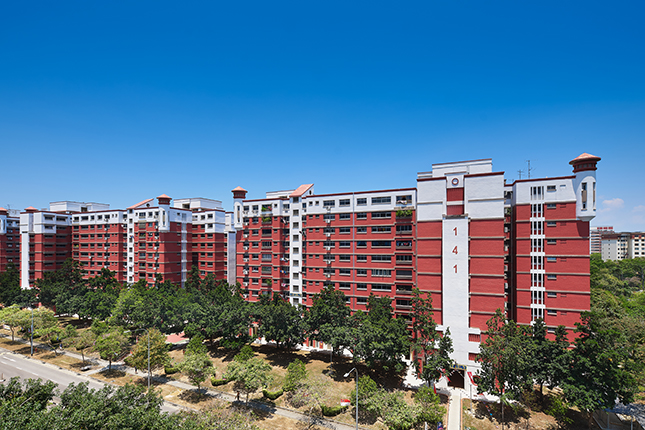
Having spent most of my childhood in Pasir Ris, those flats were certainly not alien to me and I had always found them attractive but never wondered why until then. Coming off the trail, I was blown away by the intentionality, coherence and fittingness that went into the intricate designs of the flats as well as its landscaping based on a particular theme unique to the identity and history of Pasir Ris, that is, the “seaside resort” theme – for Pasir Ris was near the beach and had multiple beachfront hotels in the past. And in that trial I witnessed with my own eyes, the artist’s (dare I say) loving intents in features such as:
“lighthouse-shaped turrets formed by columns of balconies and grille patterns inspired by traditional tropical basket-weaving designs… void decks and precinct boundary walls feature(ing) porthole-shaped openings, and flat windows and balconies are (being) framed within clam-shaped openings.” (source:Roots)
Needless to say, I was delighted and in all honesty a bit awestruck, not least with the amount of thought that went into the details but also discovering what it meant for buildings to have a “face” – a “soul”.
Roger Scruton, in his book The Aesthetics of Architecture mentions a kind of facelessness existing in modern edifices whose facades of windows simply mirrors their surroundings, lacking any soul or distinctiveness which is essentially anti-human flourishing:
“Vast and overbearing though the modern building types may be, they never acquire an air of permanence, but recreate the city as a frozen junkyard. Their raw functionality hurts the eye and the soul, for it speaks not of us and our right of dwelling, but of them. It is an anonymous they who built these things for inscrutable purposes that lie beyond our sympathies. In losing the reference to sacred architecture that inhabited our building types from the Greeks until the beginning of the twentieth century, we lose also our conception of the city, as a place where absent generations reside among the living, and the living room reside. The real cause of the decay of our inner cities, I believe, is the architecture that has killed them.” (PXII)
And sadly Singapore is not spared such a phenomenon: look around and notice the new housing developments (both private and public), are they not a far cry from the “good old flats of Pasir Ris” but instead reek of bland pungent functionality – resembling Le Corbusier’s vision of the house as a “machine for living in”?
No wonder I always felt “at home” in Pasir Ris (and other parts of Simei and Tampines) especially being in the presence of such “life-giving” architecture and landscaping borne out of the location’s historical roots and distinctive characteristics, and in the converse, a feeling of alienation and uneasiness in (regretfully) other (newer) parts of Singapore. It is my prayer and hope that the “Good Old Flats” of Pasir Ris might be loved, remain, and shine as a beacon and model for new (re-)developments to come. For Shalom!
 withaestheticeyes.com