If you were to ask me which area of Singapore is my favourite, I would unhesitatingly reply the “East” but particularly Tampines, Simei, and Pasir Ris. If you were to probe further to ask why do I fancy the “East”, my reply would be because of the unique bucolic “homey” vibe it exudes. Could it be due to a biased preference since I have been living in the “East” all my life? Possibly, but I could also list down objective reasons for my preference such as its interesting circular streets, landscaping, open spaces, lower rise buildings (due to its close proximity to the airport) enabling one to see more of the skyline, and also its organicity and “homeliness” – which, sad to see, is fast dissipating due to frenetic (even vulgar) development in a utilitarian world.
But gloom aside, I would like to highlight and commemorate one prime vestige of such organicity evinced in – what I would call – the “good old flats” of Pasir Ris.
Back in 2022, I had a serendipitous encounter with the “Pasir Ris Heritage Trial” while researching on places in Singapore to explore as part of my fulfilment of a module in teacher-college (National Institute of Education) which I eventually embarked on. That solo trip and showcase after (through an artefact which we have to create – which is made available below) led me to delve deeper into the architecture of the old public housing flats.
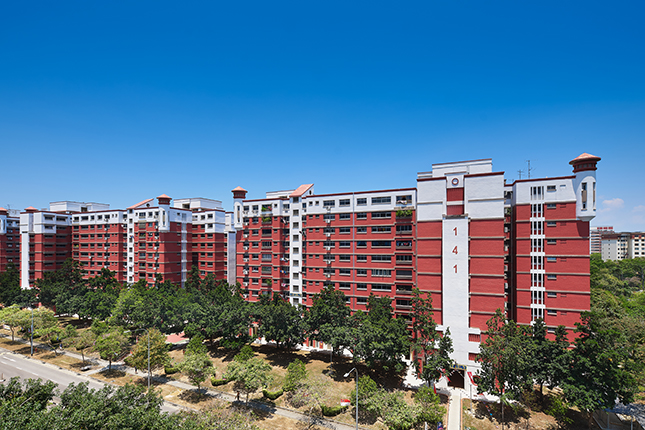
Having spent most of my childhood in Pasir Ris, those flats were certainly not alien to me and I had always found them attractive but never wondered why until then. Coming off the trail, I was blown away by the intentionality, coherence and fittingness that went into the intricate designs of the flats as well as its landscaping based on a particular theme unique to the identity and history of Pasir Ris, that is, the “seaside resort” theme – for Pasir Ris was near the beach and had multiple beachfront hotels in the past. And in that trial I witnessed with my own eyes, the artist’s (dare I say) loving intents in features such as:
“lighthouse-shaped turrets formed by columns of balconies and grille patterns inspired by traditional tropical basket-weaving designs… void decks and precinct boundary walls feature(ing) porthole-shaped openings, and flat windows and balconies are (being) framed within clam-shaped openings.” (source:Roots)
Needless to say, I was delighted and in all honesty a bit awestruck, not least with the amount of thought that went into the details but also discovering what it meant for buildings to have a “face” – a “soul”.
Roger Scruton, in his book The Aesthetics of Architecture mentions a kind of facelessness existing in modern edifices whose facades of windows simply mirrors their surroundings, lacking any soul or distinctiveness which is essentially anti-human flourishing:
“Vast and overbearing though the modern building types may be, they never acquire an air of permanence, but recreate the city as a frozen junkyard. Their raw functionality hurts the eye and the soul, for it speaks not of us and our right of dwelling, but of them. It is an anonymous they who built these things for inscrutable purposes that lie beyond our sympathies. In losing the reference to sacred architecture that inhabited our building types from the Greeks until the beginning of the twentieth century, we lose also our conception of the city, as a place where absent generations reside among the living, and the living room reside. The real cause of the decay of our inner cities, I believe, is the architecture that has killed them.” (PXII)
And sadly Singapore is not spared such a phenomenon: look around and notice the new housing developments (both private and public), are they not a far cry from the “good old flats of Pasir Ris” but instead reek of bland pungent functionality – resembling Le Corbusier’s vision of the house as a “machine for living in”?
No wonder I always felt “at home” in Pasir Ris (and other parts of Simei and Tampines) especially being in the presence of such “life-giving” architecture and landscaping borne out of the location’s historical roots and distinctive characteristics, and in the converse, a feeling of alienation and uneasiness in (regretfully) other (newer) parts of Singapore. It is my prayer and hope that the “Good Old Flats” of Pasir Ris might be loved, remain, and shine as a beacon and model for new (re-)developments to come. For Shalom!
*Image Source: roots.gov.sg
 withaestheticeyes.com